
Encyclopedia
 current location: Home > News > Encyclopedia
 Release time:2026-08-03
 page views:
 Bellows Coupling
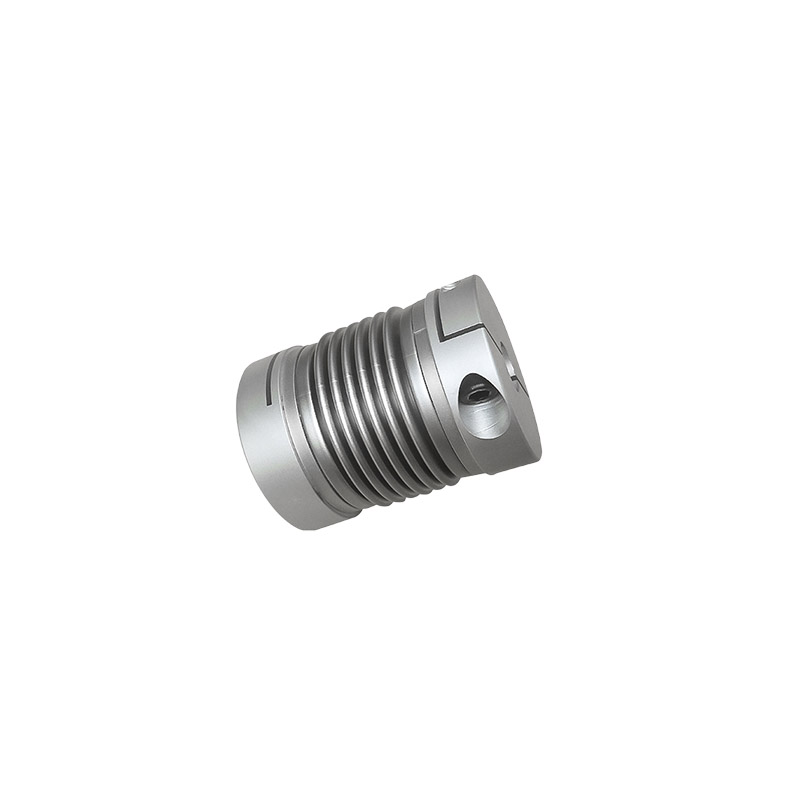
Within the core transmission chains of automated equipment, precision machine tools, robots and servo drive systems lies a compact yet vital component: the bellows coupling. Appearing merely as a corrugated metal tube assembled with connecting hubs, it acts as a critical element ensuring precise transmission, stable operation and controllable tolerance for machinery. Compared with ordinary rigid couplings and elastic jaw couplings, bellows couplings feature zero backlash, high torsional rigidity and multi-dimensional misalignment compensation. Thanks to these unique merits, they stand as the preferred option for high-precision transmission scenarios and are widely adopted in diverse precision industrial equipment. Today, we will systematically elaborate on core knowledge, performance advantages and application value of bellows couplings.
I. What Is a Bellows Coupling? Basic Structure and Working Principle
A bellows coupling is a metallic flexible coupling. Its primary function is to connect two rotating shafts (e.g., motor shaft and lead screw shaft), transmit torque and rotational speed, and adaptively compensate for various misalignments generated during shaft assembly and operation. It serves as a flexible buffer bridge in precision transmission systems.
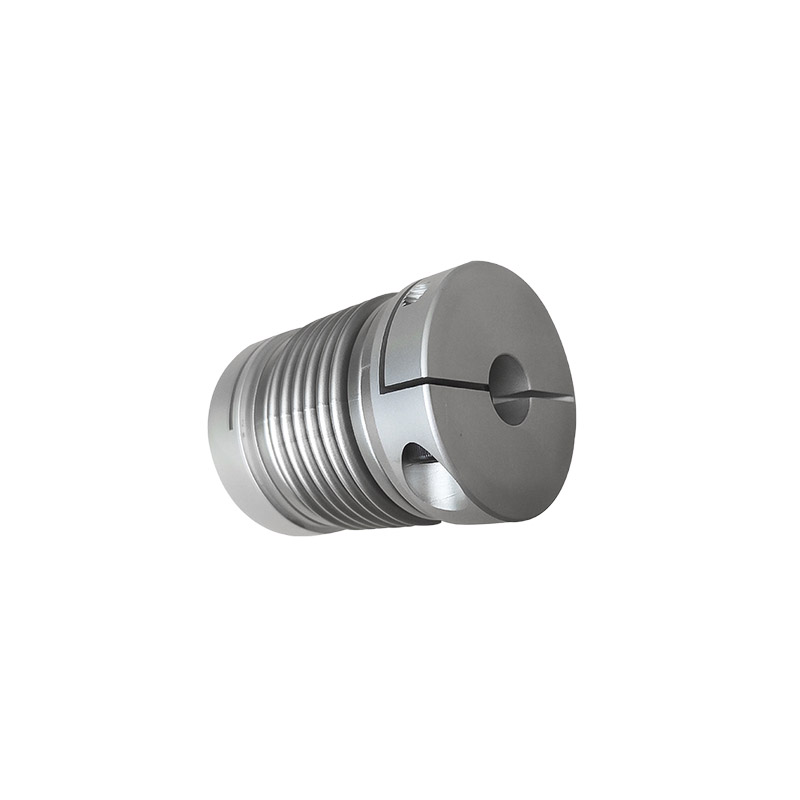
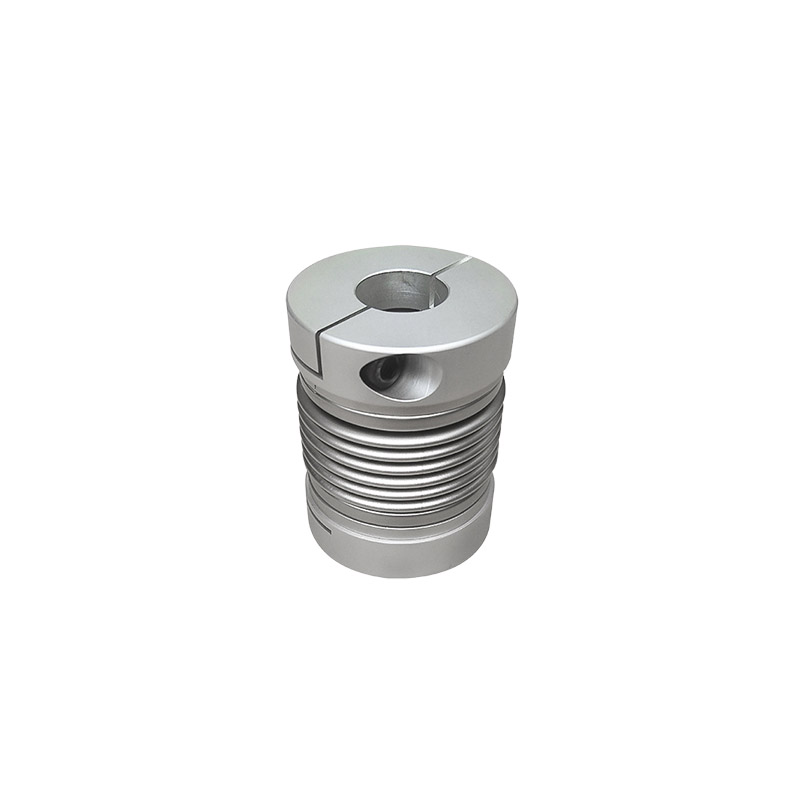
It boasts an extremely simple structure consisting of two key parts: metal connecting hubs at both ends for securing rotating shafts of matched equipment, and a thin-walled corrugated elastic bellows in the middle — the core functional component of the coupling. Most mainstream products are manufactured from high-strength thin-walled materials including stainless steel and nickel-based alloys. The bellows are firmly joined to end hubs via welding, crimping or bonding processes. Free of extra sliding or meshing components, the coupling features compact layout and outstanding durability.
Its operating principle is straightforward. Relying on uniform elastic deformation of the metal bellows, it transmits torque rigidly while accommodating axial, radial and angular three-dimensional misalignments of the shaft system. Alignment errors during equipment assembly, vibration-induced deformation during operation and shaft displacement caused by thermal expansion and contraction can all be offset through minor flexible deflection of the bellows. Unlike rigid couplings that are prone to jamming and overload, or conventional elastic couplings that produce transmission clearances and compromise accuracy, bellows couplings maintain constant rotational precision with low bearing load owing to evenly distributed stress on the corrugated thin wall.
II. Core Advantages: Why Precision Equipment Favors Bellows Couplings
Bellows couplings enjoy distinct recognition among all coupling categories. Their core strengths focus on precision, stability and adaptability, perfectly catering to high-end precision transmission requirements. These advantages also differentiate them from diaphragm couplings, jaw couplings and Oldham couplings.
Zero-backlash transmission for supreme positioning accuracy
Backlash is the arch-enemy of precision transmission. Clearances inside ordinary couplings trigger transmission lag and positioning deviation during equipment startup, shutdown and direction reversal. As an integrally rigid connection assembly, bellows couplings contain no mechanical gaps or hysteresis errors. Torque is delivered synchronously without delay, maximizing motor transmission accuracy and satisfying micron-level positioning demands for CNC machine tools, testing equipment and servo systems.
Three-dimensional misalignment compensation for superior adaptability
Absolute coaxial alignment is hardly achievable during industrial equipment installation. Temperature fluctuations and mechanical vibration in service also lead to shaft displacement. Bellows simultaneously compensate for axial expansion, radial offset and angular tilt misalignments. Low restoring force from deformation avoids extra load exerted on the shaft system and bearings, significantly mitigating equipment wear.
High rigidity plus low inertia for stable high-speed operation
Premium metal bellows deliver exceptional torsional rigidity with barely any torsional deflection during torque transmission, ensuring high transmission efficiency. Meanwhile, compact size, light weight and low moment of inertia make them ideal for servo and stepper motors operating under frequent high-speed start-stop and reversing conditions. The couplings enable smooth, vibration-free and low-noise power transmission with excellent dynamic response.
Long service life and maintenance-free operation for harsh working conditions
The all-metal construction eliminates aging-prone components such as rubber and plastics. Featuring corrosion resistance, high-temperature tolerance and fatigue resistance, bellows couplings withstand long-term frequent operation under wide temperature ranges and mild corrosive environments. Free from risks of elastic body aging, deformation and cracking, they require no lubrication throughout their service life and outlast ordinary elastic couplings. Custom versions can be designed with electrical insulation to meet isolation and protection requirements for special machinery.
III. Main Classifications: Select Models According to Working Conditions
Based on structure, mounting method and load capacity, bellows couplings fall into two primary types to match varying torque and installation requirements of equipment:
Miniature Precision Bellows Couplings
Compact in dimension with low torque rating, they prioritize ultra-high precision. Most adopt clamping-style hubs for easy assembly and disassembly while maintaining excellent coaxiality. They are mainly applied to low-power servo motors, stepper motors, encoders, precision testing instruments, small automated modules and other light-load high-precision scenarios.
Heavy-Duty Industrial Bellows Couplings
Constructed with thickened multi-layer bellows and reinforced hubs for drastically improved torque capacity. Some variants are equipped with taper locking assemblies and flanged connections for enhanced stability. They suit medium-to-heavy-load applications requiring high stability, such as precision machine tool spindles, large automated equipment, semiconductor machinery and industrial pumps.
IV. Wide Range of Applications
Benefiting from high precision, stable performance and maintenance-free features, bellows couplings are applied across nearly all precision transmission sectors. Key application scenarios are listed below:
Precision Processing Equipment: Power transmission between motors and lead screws for CNC machine tools, engraving machines and grinders, securing machining accuracy and eliminating workpiece dimensional errors.
Intelligent Automation Equipment: Robotic joints, linear modules, manipulators and 3C automation equipment, accommodating frequent start-stop cycles and precise positioning operations.
Testing & Instrumentation: Encoders, resolvers, precision measuring instruments and laboratory testing equipment, guaranteeing error-free data acquisition.
High-End Special Equipment: Semiconductor manufacturing machinery, medical devices, precision packaging machinery and new energy equipment, satisfying strict standards for cleanliness, stability and high precision.
General Industrial Equipment: High-precision fans and industrial pump units, reducing operational noise and abrasion while cutting maintenance costs.
V. Guidelines for Selection & Application
To achieve optimal performance of bellows couplings, proper model selection and standardized installation are essential. Three key points should be noted during application:
Match torque and rotational speed
Select couplings according to the rated torque, peak torque and maximum operating speed of equipment, with a safety margin of 1.2 to 1.5 times reserved to prevent overload deformation and accuracy degradation.
Control installation precision
Although capable of misalignment compensation, couplings cannot remedy excessive assembly offsets. Coaxiality of the shaft system should be optimized during installation; long-term eccentric operation will accelerate fatigue failure.
Select materials suitable for operating conditions
Standard stainless steel bellows suffice for general working environments. Nickel-based alloys and special stainless steel grades are recommended for corrosive or high-temperature conditions to boost adaptability and service lifespan.
VI. Conclusion: Small Component, Great Precision
Boasting an uncomplicated structure, bellows couplings serve as indispensable premium transmission components thanks to zero backlash, high rigidity, multi-dimensional misalignment compensation and maintenance-free performance. They resolve pain points of conventional couplings including insufficient precision, severe wear and limited adaptability, and realize outstanding transmission stability via a minimalist design. These components underpin the rapid advancement of modern precision manufacturing and automation technology.
From micron-level testing instruments and high-precision CNC machine tools to intelligent robots and top-tier industrial machinery, these tiny corrugated tubes consistently enable accurate power transfer and stable operation. They act as unsung heroes advancing industrial precision manufacturing.


Hotline:
+8615066616606 hq@hqcplg.com



 No. 188 Kunlun Road, Hongyun Development Zone, Qingyun County, Dezhou City, Shandong Province