
Encyclopedia
 current location: Home > News > Encyclopedia
 Release time:2026-08-13
 page views:
 Shock-absorbing Coupling: Flexible Buffer Guardian of Transmission System
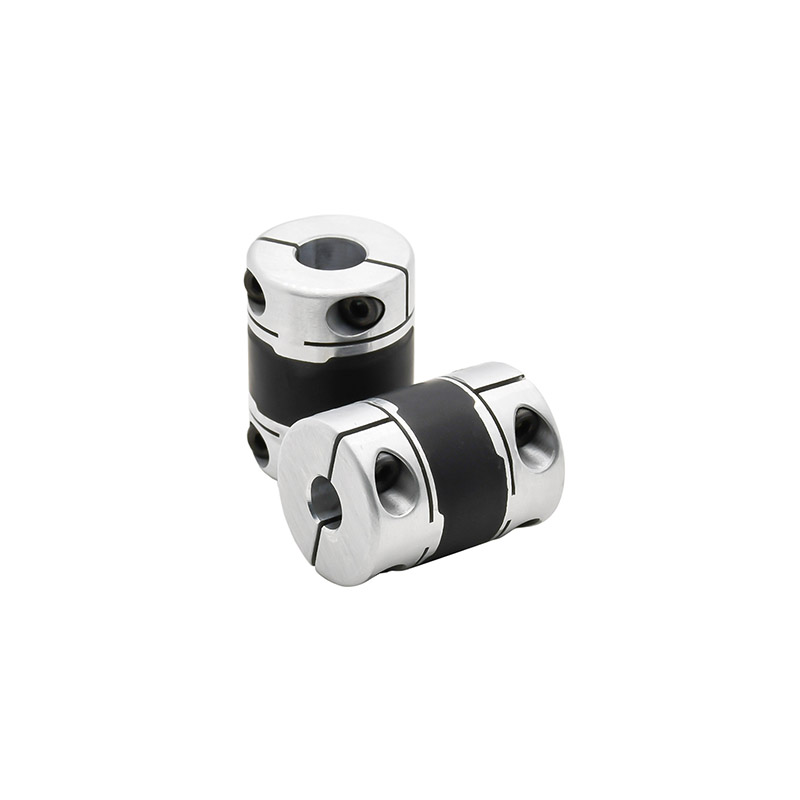
1. What is a Shock-absorbing Coupling
Shock-absorbing coupling, also widely referred to as damping coupling, falls under the category of elastic couplings. Installed between the driving shaft and driven shaft, its primary function is power transmission. It absorbs impact loads, suppresses vibration through elastic component deformation, and compensates radial, angular and axial misalignment arising during equipment assembly. It is an indispensable component for transmission systems including motors, pumps and automated machinery.
Rigid couplings transmit torque via direct metal contact and cannot accommodate assembly misalignment. Vibration will transfer throughout the whole shaft system. In contrast, shock-absorbing couplings achieve flexible transmission by utilizing elastic structures. They dissipate sudden impact energy and prevent vibration from propagating to bearings, reducers and motor rotors, effectively lowering the risk of component fatigue failure.
2. Basic Working Principle
A standard assembly consists of two metal hubs and an intermediate elastic buffer insert.
Impulsive loads are generated during equipment startup, load fluctuation or frequent forward and reverse rotation. Elastic components (polyurethane, rubber, metallic elastic elements) undergo reversible deformation to realize the following functions:
1. Shock buffering: Absorb instantaneous peak impact force and reduce torque pulse peaks;
2. Vibration damping: Restrain vibration transmission between the power end and load end, minimizing resonance risks;
3. Misalignment compensation: Make up for assembly errors, thermal expansion and shaft displacement caused by frame deformation;
4. Noise reduction: Eliminate harsh metal contact noise. Certain non-metallic elastic elements also provide electrical insulation.
Important Reminder: Shock absorption has limitations. Elastic components possess fatigue thresholds. Under sustained heavy impact, elastic parts will age and crack, requiring regular inspection and replacement.
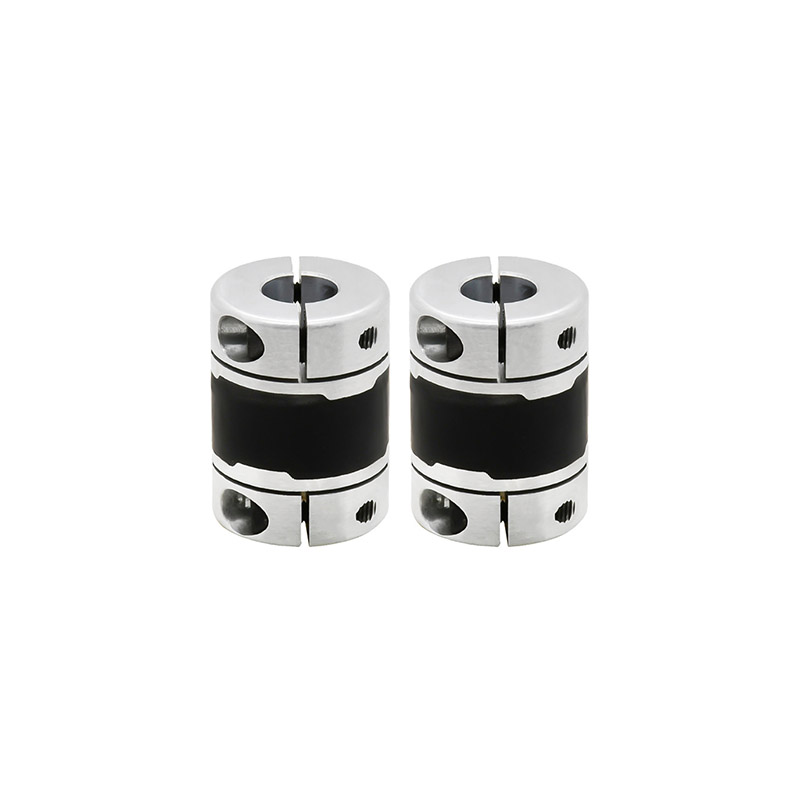
3. Main Types of Shock-absorbing Couplings and Applicable Working Conditions
(1) Jaw Coupling
The most commonly used shock-absorbing coupling. Two coupling halves feature claw teeth, matched with a jaw-shaped polyurethane insert.
Advantages: Compact structure, maintenance-free without lubrication, simple installation and disassembly, balanced shock-damping performance;
Limitations: Axial clearance must be reserved during installation; severe eccentricity accelerates wear and failure of elastic inserts;
Applications: Water pumps, fans, general automation equipment, transmission for medium and small reducers.
(2) Tyre Coupling
It adopts a rubber tyre as the elastic element, with outstanding misalignment compensation and excellent buffering performance.
Advantages: Capable of resisting violent impact and tolerating relatively large angular misalignment;
Limitations: Larger outer dimension; rubber materials tend to age rapidly under high-temperature environments;
Applications: Mining machinery, construction machinery, heavy-duty equipment with frequent forward and reverse operation.
(3) Pin Coupling
Torque is transmitted through nylon or rubber pins.
Advantages: Wide allowable torque range and high assembly tolerance;
Limitations: Shock absorption performance is inferior to jaw couplings and tyre couplings;
Applications: Conveyors and general industrial transmission equipment.
(4) Bellows Coupling
It adopts an integrated stainless steel bellows as the elastic element. Designed for zero-backlash, high-precision motion and excellent misalignment compensation, yet its shock absorption capacity is limited.
Advantages: Zero backlash, fast dynamic response, oil resistance and corrosion resistance;
Limitations: Poor resistance to impact loads, relatively high cost;
Applications: Servo motors, precision testing instruments, CNC machines.
Critical Distinction: Universal Joint ≠ Shock-absorbing Coupling
Universal joints are developed mainly for power transmission between intersecting shafts, focusing on compensating large angular deflection. Ordinary cross universal joints offer nearly no shock absorption. Only composite universal couplings equipped with extra elastic structures can deliver buffering effects. Please avoid confusion during model selection.
4. Material Characteristics of Common Elastic Components
1. Polyurethane (PU): Dominant material on the market, wear-resistant and oil-resistant with moderate shock absorption. It will age and embrittle quickly under prolonged working temperatures above 80℃;
2. Natural rubber: Delivers superior vibration damping, yet poor oil resistance and susceptible to corrosion by lubricants;
3. Stainless steel / spring steel: Metallic elastic material, high-temperature resistant and anti-aging. Its vibration damping performance is weaker than polymer materials, mainly used for high-precision scenarios;
4. Nylon: Widely adopted for pin-type structures, stable load capacity, mediocre toughness at low temperatures.
5. Core Industrial Selection Guidelines (Practical Engineering Standards)
1. Safety factor for torque margin
For directly started equipment and machinery with frequent start-stop cycles, a safety factor of 1.8~3.0 is recommended; 1.2~1.5 for variable-frequency soft-start systems. Selecting products merely based on rated torque will easily result in elastic element fracture.
2. Classification of impact levels
Light impact: Fans, centrifugal water pumps; Medium impact: Conveyors, packaging equipment; Heavy impact: Crushers, forging machinery. Tyre couplings and grid couplings are preferred for heavy-impact operating conditions.
3. Material selection according to working environment
Choose polyurethane for sites with hydraulic oil and lubricants; avoid rubber materials under high temperature; stainless steel hubs can be selected for humid and corrosive environments.
4. Control assembly misalignment
All shock-absorbing couplings have maximum allowable misalignment values. Smaller alignment errors during installation mean longer service life.
6. Typical Application Industries
Water pump units, air compressors, automatic production lines, packaging machinery, metallurgical auxiliary equipment, construction machinery, woodworking machinery, conveyor equipment, generator supporting transmission systems.
7. Common Application Misunderstandings
1. Misunderstanding: Shock-absorbing couplings can compensate excessive assembly eccentricity.
Fact: Elastic compensation only provides limited tolerance. Never rely on couplings to offset severe shaft misalignment, which will lead to premature failure under long-term eccentric operation.
2. Misunderstanding: The machine must shut down immediately after the elastic insert is damaged.
Fact: Jaw couplings feature a fail-safe design. After insert breakage, metal claw teeth engage with each other to support short-time operation. Nevertheless, intense vibration will occur, and shutdown for replacement is required promptly.
3. Misunderstanding: All couplings can absorb shock.
Fact: Flange rigid couplings and basic gear couplings barely have vibration damping capacity and should not be directly applied under impact working conditions.


Hotline:
+8615066616606 hq@hqcplg.com



 No. 188 Kunlun Road, Hongyun Development Zone, Qingyun County, Dezhou City, Shandong Province